Putting batteries in parallel adds the Ah capacity, but maintains the voltage. This is common practice for many reasons. Smaller batteries can be easier to handle, are sometimes cheaper, or sometimes it’s just what’s available or in budget at the time. Whatever the reason, the following points are a MUST for anyone doing so.

If you’re not confident about any of this, or unsure, always seek the help of a professional. It’s not worth the risk of making a mistake. https://powerpaul.com.au/stockists-and-installers-directory/
Timing… Ideally you should use the same brand, age and model of battery. This more or less ensures identical performance throughout the life. While different age batteries have a significant effect for AGM batteries, it’s much less so for LiFePO4, however it’s still present.
Brand… Avoid mixing brands. The primary reason is that both brands will immediately void your warranty. This is because they cannot guarantee how their battery will work in parallel with another brand. Technically it’s “ok”, however at the top and bottom ends of the SOC curve, things get tricky and different BMS’s can behave in unpredictable ways. Mixing these can result in undesirable or dangerous interactions.
Capacity… Again, ideally they should be the same, this helps ensure equal deterioration over time, and this helps the whole system last longer as they won’t be counteracting each other.
Voltage… It goes without saying (but we’ll say it anyway) that you must not mix voltages or chemistries of batteries. If you run a 12v system, only use 12v batteries. The terminal voltage of each battery should also be almost identical when putting in parallel. A difference of 0.1v is ok in most circumstances. The batteries should also be fully charged individually, and left to “settle” for 12+ hours before placing them in parallel. This helps reduce the chances of significant current flow when you do connect them.

Fusing… A fuse must be used on the battery bank. The rating for this depends on factors such as wire size, and system current requirements. While it’s not a requirement to fuse every battery individually, it’s ideal if you have the space to do so. The Victron Lynx Power In is good for this, but there are plenty of DIY methods too. MRBF fuses are ideal for this. https://powerpaul.com.au/fuses/

Wire length and size… It’s best to ensure wire lengths are identical between batteries when connecting them. If there’s a bit of difference, there’s rarely any serious negative effect, however a big difference can result in odd power sharing issues. Parallel cables should also be sized the same as what you require to run the system.
Charge and discharge current… Having 3 x 100A (BMS) batteries in parallel sounds like you can drain them at 300A combined, on paper this works, but in practice it’s better to de-rate them a bit. A total of 50% is a safe bet for cheap batteries, but good quality batteries should be fine to consider 75-90% of the rating. In the example above, 3 x cheap 100A BMS batteries will safely provide 150A continuous. However 3 x quality 100A BMS batteries should provide you with 225-270A continuous. The current sharing “quality” becomes the problem at the top and bottom ends of the charge curve, it’s rarely an issue in the 10-90% SOC range. The same goes for charge current.

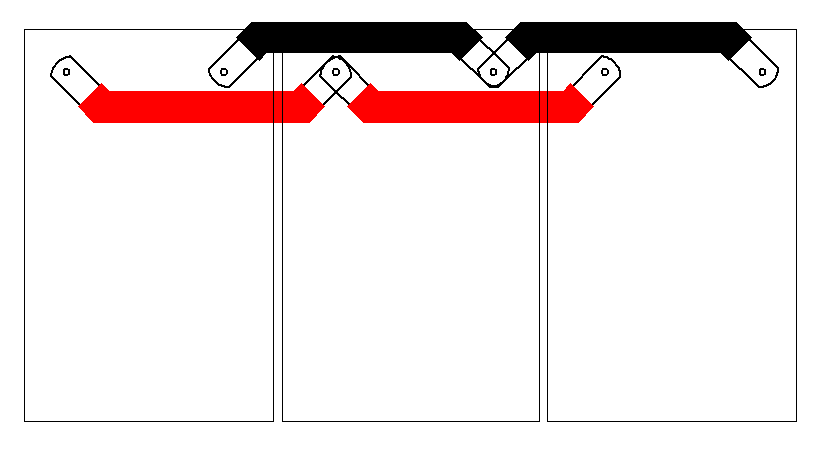
Connection method… You can connect them in parallel at the batteries, and then use cables to the system, or you can use cables from each battery to the system. Either way is ok providing you set it up correctly. Always remember if using the former method, take the positive and negative from opposite ends of the battery bank to share the load evenly.
Keep it neat… One of the best ways to avoid mistakes and confusion, is to keep your wiring neat and tidy. Use different colour wire appropriate for the task, red for positive and black for negative. Or at least identify the ends of the wire with red or black heatshrink or tape.
Connection order… Batteries get connected LAST! This avoids having live wires floating around that can accidentally short on other parts. Batteries should also be the first thing to be disconnected when working on or modifying your electrical connections.

Fuses, Switches and/or Breakers… The typical circuit breakers are a thumbs down from us, we’ve seen too many of them fail, and even more fail to perform acceptably. Some of the high end brands like Noark are great, but the price is high and size is big. Fuses are a good, safe, reliable and cheap method. Carry a couple of spares for each size, and you should be set for a long time. Providing they are sized and installed correctly, they will only blow when there’s a real problem, and if that happens you should be fully checking the system before replacing them. Disconnect switches to completely isolate the batteries are an excellent idea and should be installed into every system. They provide you with a way of cutting off all charge and discharge when storing the vehicle for extended periods, and if you every need to cut power quickly for any reason, it’s a simple twist to do so. Ensure the switch is easily accessible.
Also remember that there are some complex guidelines around adding batteries to systems, or upgrading them. See our fitment guide for a very brief placement description, but if in doubt seek professional help. https://powerpaul.com.au/wp-content/uploads/2024/05/PPA-Installation-Guide.pdf