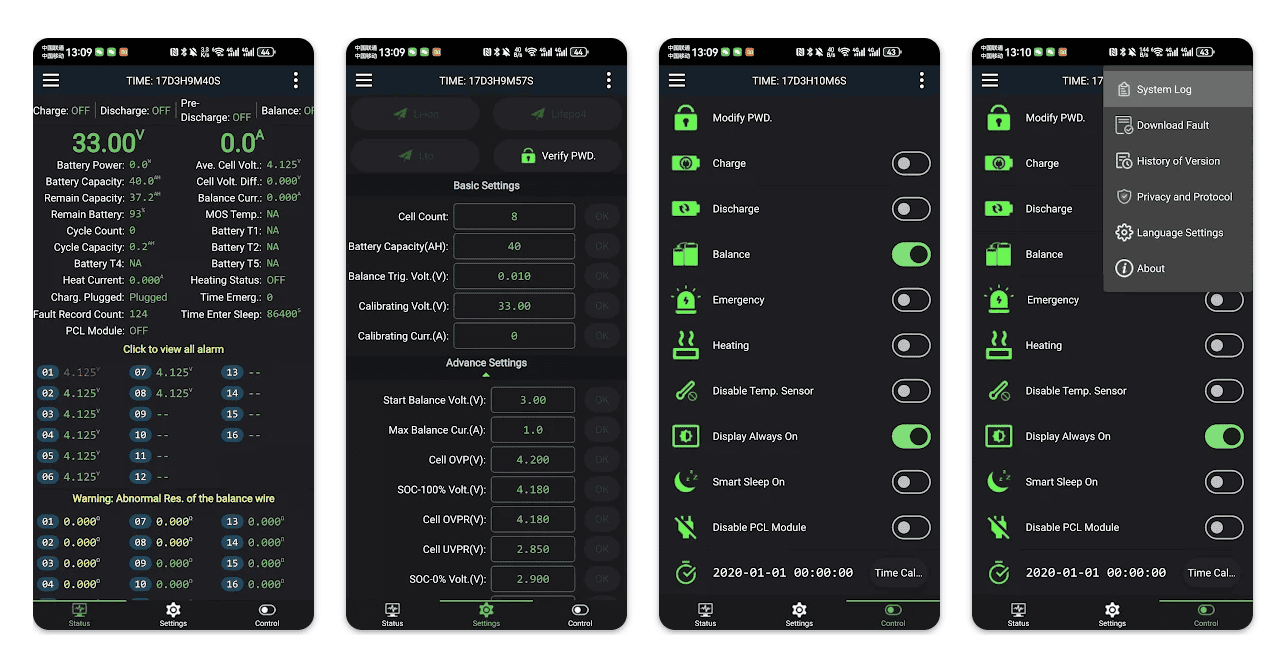

We know trusting a BMS State Of Charge is something that people think is impossible, but we’ve been working on proving this to be a myth, at least for our custom BMS.
There are always caveats, these include batteries left sitting doing nothing, the readings do tend to be skewed. BMS’s don’t usually take into account the self-discharge of cells, and also don’t usually take into account the energy used by the BMS itself. Energy used for an external balancer is also not counted. Temperature variations are also not taken into account. Shunts are completely separate from the battery, so they also cannot include these energy losses/usage (at least none that we know of).
So what’s the solution?
Officially there is no perfect solution, but PowerPaul has the best option yet (IMHO). The custom program we use, and our own settings, do an incredibly good job of providing accurate SOC readings. In the majority of cases this will be as good or better than using a Victron Smart Shunt… I know, you can stop laughing and pick yourself up off the floor now. We’re happy for people to put the latest versions of our batteries to this test though, getting more feedback will help us make it better. Batteries manufactured in the past few months with the latest software have undergone very extensive set-up procedures.
We’ve done testing in various setups. The latest result is from our own van with a PowerPaul Nifty, a Victron Smart Shunt, and an Evakool drawer fridge. This is charged from the alternator only, so if the vehicle does nothing for a while, it struggles to keep the fridge going 24/7. Generally it will run for about a week without any engine charging.
During the past few weeks, it hasn’t reached full charge during short drives, so it waned a little each day. Almost a week ago the Shunt suggested 45%, yet the BMS suggested just 9%. The BMS was almost spot on! When the van was next started, the shunt still had about 35% memorized, which is of course incorrect. Victron shunts do not set themselves to 0% when it’s flat (they should though), so this is an inaccuracy that accumulates. The only way to calibrate the Victron Smart Shunt is to reach full charge, or to do it manually via the App.
But our BMS does “calibrate” itself to 0% when it’s flat, and 100% when it’s full. It also takes into account the self discharge of the cells, and the energy used by the BMS itself. What it lacks is resolution down at very low current levels. Below 700mA we can’t be sure of the accuracy. A currents of 10A or more are something we find significantly more reliable.