

What felt like was a week ago (but was actually a month), we showed an image of a few BMS’s that we have for testing…

We got around to testing them a few days ago.
The first one on the bench was the ANT BMS, which is rated at 400A. It was easy to set up, the App was informative and easily used too. Power handling was also good but we didn’t test up to the limit for this round of testing. It got to over 60 deg C with a decent >30min 3000w load. Voltage drop across the input and output got to about 60mV which is ok.

The second was the E&J BMS rated at 300A. We first connected this and it didn’t work. After much searching for the BT module we gave up due to lack of time. However the next day I looked again and found a silly mistake… I connected it wrong. It’s a weird setup where both the negative and positive go through the BMS. I don’t know why they chose this but ultimately it does work (whoops). HOWEVER… When we did connect it up again and ran it the same way as the others, it’s power loss was awful. Dropping about 120mV means it produced 2-3 times the heat as the other 2 tested, and this was clearly obvious with the temperature after a short time. The App also has a message saying that it tracks usage regardless of if the App is running or not, and this was another red flag. We’re not paranoid here, but this lack of privacy for no good reason concerns us. There’s also the annoying thing that the temp sensor and BT module use the same style connection, this is bad practice when designing things like this.

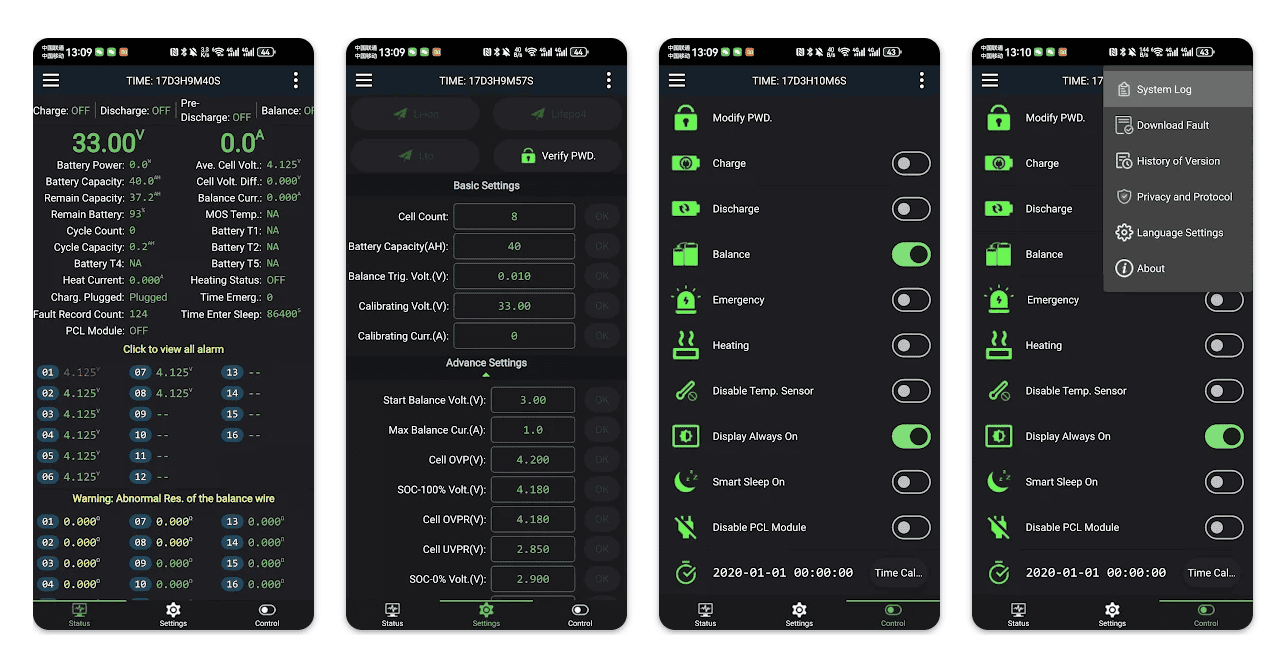
The third was the JK BMS rated at 300A (higher for short periods). This one took the crown in so many respects. The App is easy to use, even if it’s a bit bland and data oriented. The lack of pretty pictures and any graphics is frustrating, but it’s really something only required during set up or fault finding. It’s power loss was also admirable, with a voltage drop of less than 50mV when loaded up to 3000w. The balancing function is also pretty much the most advanced of all the BMS’s available right now. This saves us the hassle of a separate balancer and custom wiring loom. Since this BMS was the clear winner, we took it to the next level and did short circuit testing. Impressively it did everything exactly as it should do.

We will re-test the Daly BMS to check its voltage drop soon.
At this stage we’re considering the JK BMS for some new batteries in the pipeline, with the possibility of grafting it into the existing range when stocks of the DALY BMS run low. We’ll be doing some more testing soon. We also need to delve into the option of getting them custom programmed with our settings, or a simple way for us to do the programming here. Andy’s Off Grid Garage has discussed the tedious programming quirks on his YouTube channel if you want to see more of that.
*** I have just noticed the JK BMS is slightly warm, even though it’s been doing nothing for over 24hrs. This could be due to some of the settings we were fiddling with such as a 0.001v balance delta, but we’ll investigate before going any further.



Thanks Paul, good info. Are you going to test the Mueller 250A BMS as well? Would be interesting
We have tested it already. It’s good but we’re looking for higher current this time.
Thanks Paul