Today we commenced the final assembly of the next generation (3) of our test rigs.

This update provides us with more accuracy, less energy loss, faster testing and higher charge currents. Our regular testing will be at approximately 2000w, or close to 150A discharge. However if we want to do some heavy testing we can easily boost up charge currents to about 200A and discharge up to about 400A.

Cable upgrades bringing the high current cables up to 70mm2 will reduce some heat. We know it’s technically a bit under-spec’ for running 250A, but this is not a critical situation so we are ok with those losses for the sake of cost and ease of working with.
We also went back to assembling our own cables after having a less than acceptable experience having them made elsewhere.

Each test rig uses 2 x Victron Smart Shunts. 3 x Victron Orion XS DC-DC converters, a 16v 60A power supply and a 3000w Renogy inverter. This setup provides versatility for both high and low current testing, single or dual battery testing, and also results in an efficiency of about 90% to help reduce energy costs.
The rigs also fit in a small footprint and sit on a shelf above the battery bench. In a 2m space, we can fit 8 batteries and 4 test rigs. It’s expected that with tight timing, we can get testing down to almost half what it used to be, enabling us to process 24 batteries a day.

The Orion units are fan cooled to ensure they can run at 100% continuous. We use a 24v fan from 12v, so it’s silent yet still pushes enough air. Having it quieter will be a comfort bonus, as the previous rigs could often have up to 5 fans running at once, which gets noisy. It’s also low power and results in very low wear and tear, saving us from replacing fans regularly. The fan only runs when the DC-DC’s run. The DC-DC rate can be selected to 50A, 100A or 150A by quickly switching a rotary switch. This saves the fiddly task of logging into the App.

We also have a 7″ Tablet mounted to each test rig. This displays both shunt readings, as well as all 3 DC-DC converter stat’s at once. The Shunts are also able to be connected to the VRM by a Victron Ektrano unit, however we will not run that just yet (no need at this stage).
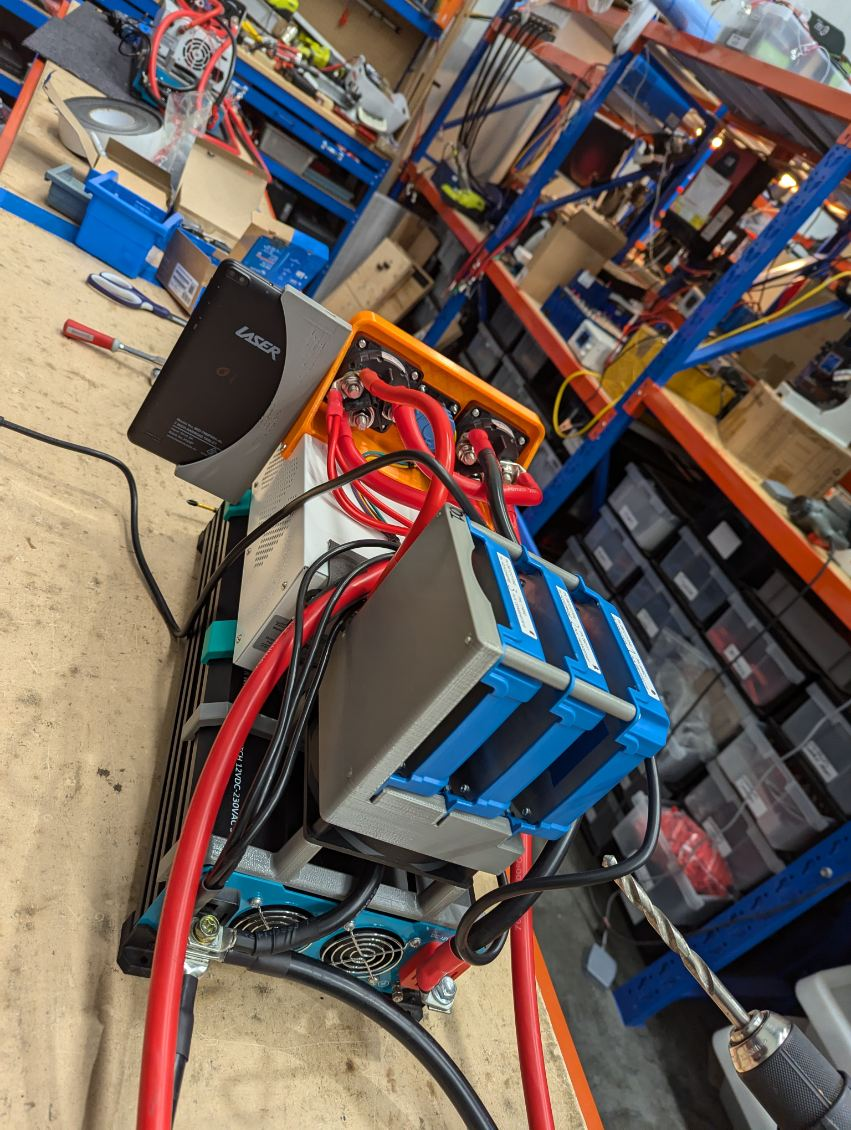
Assembly is involved, but actually simpler than our previous versions. The more modular approach has been a bonus and all the things we’ve learned over the past 3 years have culminated in this latest version. And we’re back to using a common negative system which is preferred instead of the common positive of the previous test rigs.